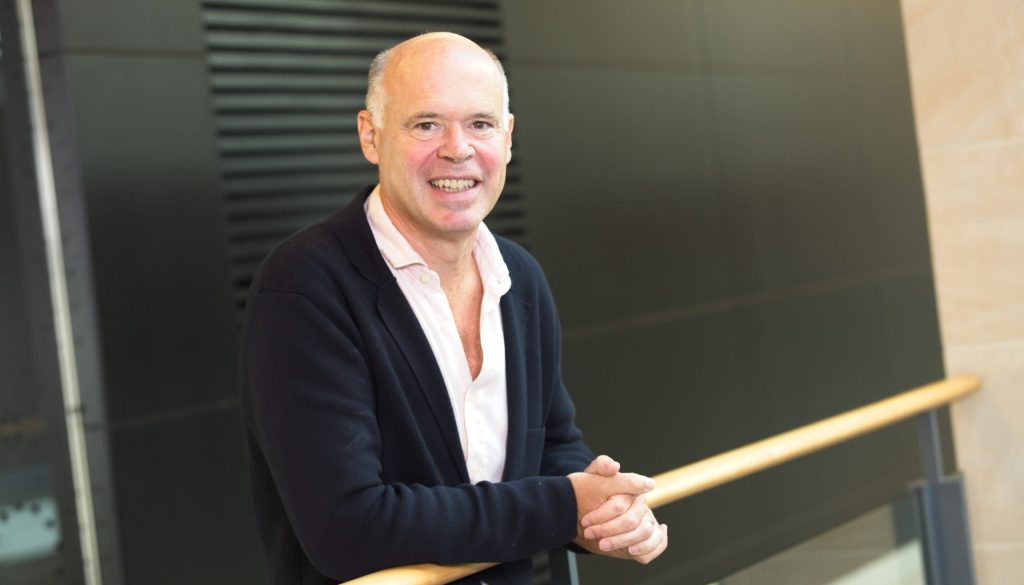
Alastair Campbell speaks about how financial health came to be a lifelong career pursuit, and the book that grew out of it.
Over the course of his 30-year career in banking and strategy, Alastair Campbell has been driven by the simple belief that money should make people’s lives healthier, not harder. This premise has followed him from boardrooms of major financial institutions to markets where financial fragility is part of everyday life.
Across senior leadership and advisory roles spanning both developed and emerging markets — including Standard Chartered, HSBC, NatWest, and CTBC, as well as at global strategy firms Oliver Wyman and Marakon — Alastair repeatedly encountered a disconnect between how systems are designed and how people actually manage their financial lives.
Now, as Chief Commercial and Strategy Officer at 361 by FINCA, FINCA’s new platform that’s bringing modern banking technology to inclusive finance, Alastair is doing what he’s long argued for: building a banking system that genuinely supports financial health. His conviction that the industry must fundamentally rethink how it serves people is also what led him to write his new book: Healthy Money: Building the Bank of the Future Around Financial Health, Data Networks and Ecosystems.
We sat down with Alastair to talk about where his passion comes from, why financial health has become the organizing principle of his work, and how the ideas in Healthy Money are coming to life through the development of 361 by FINCA.
Why do banks understand products so well, but people’s financial lives so poorly?
Banks are designed to manage for soundness, being prudent with their balance sheet, measured in their approach to credit risk, and diligent about operational risk. This is vital to their institutional health and to keeping deposits safe and money flowing through the economy. We should never underestimate its importance.
What banks are less good at is understanding and building services around people’s financial lives. Banks tend to see customers as accounts, balances, or risk scores — whereas in real life, people are managing obligations, aspirations, relationships, and uncertainty. Money is incredibly emotional; it’s probably the biggest source of stress and relief people experience.
Yet, that complexity rarely shows up in the systems banks build, which is why products so often feel misaligned with how people actually live. The industry has never truly centered on the financial health of customers, whether banked or unbanked.
What inspired you to write Healthy Money, and why now?
For many years, I have been observing how this account‑centric mindset shapes the entire banking industry. Systems revolve around what the bank owes the customer or what the customer owes the bank. And while innovation continues, it’s rarely in service of how people genuinely experience money.
That disconnect, and the fact that we finally have the tools to address it, is what pushed me to write the book. The stakes and the opportunity are at an all-time high: The gap between what is technologically possible and what exists in banking has never been wider, especially for those with fewer financial resources. We now have the tools to build systems that genuinely improve financial health at scale. The question is whether we choose to use them.
How do you define financial health?
I define it as a combination of three things: discipline, resilience, and agency. Discipline is the sense that the money coming in and going out is under control. Resilience is being protected against things going wrong and bad luck. And then there’s a third dimension that consistently emerges when you listen to people and observe their behavior: a sense of agency. It’s about having the freedom to make choices, deciding how to spend and prioritizing what matters.
What is the core thesis of your book?
The core idea is simple: Banking should be designed around financial health as the primary outcome, not as a byproduct. Getting there requires rethinking who banks design for, and how.
First, banks need to design for real lives. Too many systems still assume an outdated model of stable employment and predictable expenses: one job, one household, one income stream. That’s simply not how most people live, especially in low-income settings. Instead, we should be building for blended families, microentrepreneurs, and people managing volatile income streams. Solve for the hardest cases first, and the rest will follow.
Second, banks need to rebuild their technology with financial health at the center. That requires banks to:
- Create fungible products that adapt across use cases instead of rigid product silos.
- Act as custodians of customers’ financial lives, holding their identity, relationships, and habits in trust, not just their accounts.
- Allow for contingent transactions, so rules and repayments can flex with real conditions.
What makes this such a pivotal challenge for inclusive finance?
Over the past 20 years, we’ve seen tremendous progress in the expansion of financial access to people living in poverty. Billions of people have gained access to bank or mobile money accounts, yet this access has not reliably translated into resilience, growth, or security.
One of the most persistent challenges in the inclusive finance sector is ensuring people can get the productive credit they need to improve their livelihoods. In Africa alone, there are approximately 230 million microentrepreneurs, and over 80% lack adequate access to formal credit. What this demonstrates is that even when people have accounts, the products available to them are too inflexible to be useful.
Why is FINCA building 361 by FINCA and how does it support customers’ financial health?
For millions of people living in poverty, existing microfinance products don’t work because they are built on outdated technology that can’t accommodate seasonal cash flows, multiple income streams, and unique livelihoods. The 361 by FINCA platform is changing that by bringing modern banking-grade technology to the sector so that financial institutions can offer solutions that meet their customers’ real needs and improve their financial health.
A configurable banking system will enable us to finally build products tailored to how low-income customers earn, spend, and recover from shocks — rather than asking customers to fit into rigid, one-size-fits-all structures.
A simple example is a subsistence farmer who wants to move into cash crops, where the earning potential is greater, but income may arrive only once or twice a year. With 361 by FINCA, we can offer what is essentially a reverse-cycle loan. The customer receives small advances throughout the year and repays at harvest. We can also embed protections like weather insurance, so repayments adjust accordingly if the season is poor.
361 by FINCA supports discipline, because it aligns payments with the rhythm of earning. It supports resilience because customers are protected when conditions worsen. And it supports agency because it makes transitions possible that might once have been out of reach.
Looking ahead, what gives you the most optimism about the future of financial health?
We now have the technology to design around the barriers low-income customers face, building systems where healthy financial behavior is the default, not the exception. People deserve to be treated as individuals, and for the first time, that is possible.