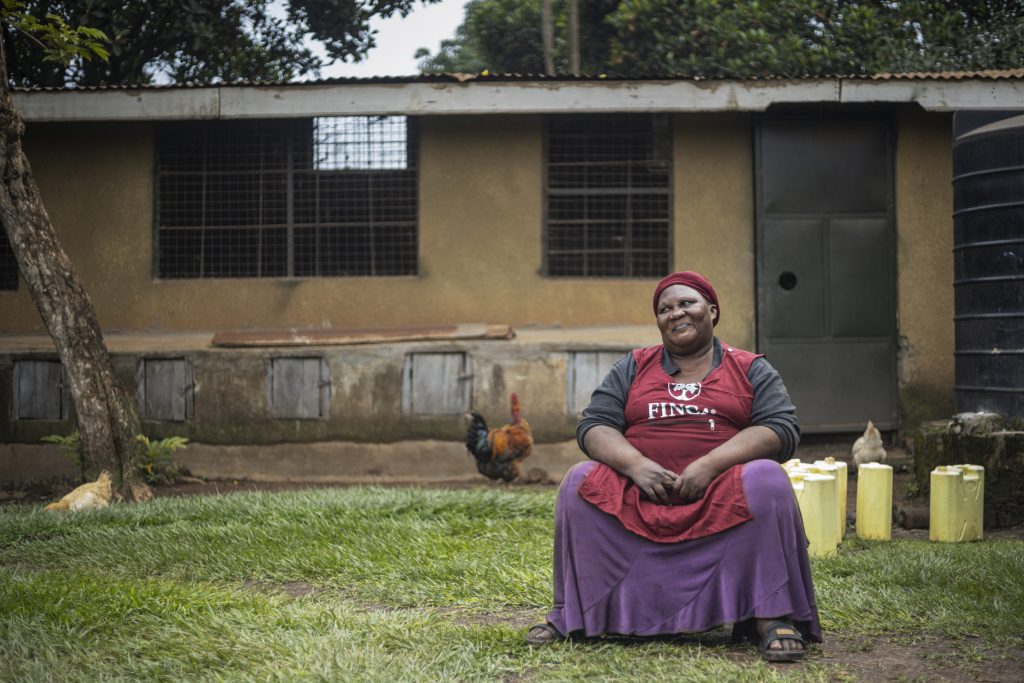
An International Women’s Day conversation about reaching women at every step of their financial journey.
At FINCA, we have spent over four decades working to eradicate poverty and get more capital into the hands of more entrepreneurs who are excluded from financial systems — and we have always put women at the very center of our work.
We know that when we empower women, they uplift their families and communities. And we know that doing so is good for business and the economy: The World Bank estimates that closing the $1.7 trillion gender financing gap could add $5-6 trillion to global GDP. Yet the systems meant to support financial inclusion still leave many women navigating barriers that restrict their access to capital, business growth, and long‑term resilience.
This year, in honor of International Women’s Day, I joined three of my colleagues on a webinar to discuss effective strategies for advancing women’s economic empowerment in practice: bringing services closer to where women live and work, investing in women founders building solutions for their communities, and using data and research to tailor products to women’s unique needs.
Starting with Women’s Realities
The first step in building systems that work for women is understanding what their financial lives actually look like. In many of FINCA’s markets, including the Democratic Republic of Congo (DRC), that reality includes traveling long distances to visit branches, living through conflict, disease, and climate shocks, dealing with irregular and unpredictable earnings, lacking the documentation and collateral required by banks, and the daily balancing act of caregiving and commerce.
FINCA DRC’s Deputy CEO Sibia Ngayihembako experiences these conditions firsthand. “Women are the ones driving community growth,” she said. “They dominate the local market through their small businesses and act as the financial backbone of the home.” Yet the obstacles they face are significant. Gender norms have long restricted financial autonomy, and limited infrastructure means that in a country as vast as DRC, simply reaching an upcountry branch for HQ staff can require flying to another city. “We need safe access,” Sibia noted. “Women shouldn’t have to travel too far or lose a day’s income just to access our services.”
Sibia described FINCA DRC’s commitment to showing up for women customers through the most challenging circumstances. “Our job is not only to give them access to a loan that they dearly need, but to get closer to them and be as fast as possible,” she explained. Digital channels keep services available through conflict, flood, and disruption, reducing the time and cost of making deposits and repaying loans. Women rely on this continuity when conditions around them shift without warning.
FINCA has also built up the country’s largest agent banking network of 1,700 agents, who process more than 80% of transactions and generate 85% of referrals. And women agents have proven particularly effective: an IFC study using FINCA DRC data found that women agents outperform men in generating revenue, because they attract more women customers, who have stronger repayment records. “The primary purpose of the agency network was to get closer to the customer,” Sibia said. “With time, our customers redefined what it means. It became a place where they can get information about our products and access reliable finance.”
Backing the Women Who Are Building What’s Next
Women running microenterprises aren’t the only ones facing barriers to capital. As the Managing Director of FINCA Ventures, FINCA’s impact investing arm, Winnie Mwangi works with women founders building companies that improve daily life across Africa. As Winnie put it, “women are much closer to the critical challenges in the ecosystem and best suited to develop solutions to address them.”
While many African startups have strong fundamentals and clear traction, they still struggle to secure patient, risk-tolerant capital. The continent receives only 1% of global venture capital investment, and an even smaller share goes to women founders. Additionally, these entrepreneurs often lack the networks, technical support, and market access that enable young companies to grow.
FINCA Ventures pairs investment with hands‑on support so founders can test their models, strengthen operations, and reach new customers. Winnie and her team intentionally back women‑led ventures that are designing solutions to improve women’s lives in deep resilience sectors like agriculture and healthcare. Forty‑one percent of active FINCA Ventures investees have women founders, and 89% of the finalists of the FINCA Ventures’ Prize Competition have women on their founding teams.
Designing and Scaling Products that Work for Women
Financial inclusion cannot deliver on its full promise until products reflect the way customers — especially women — earn and manage money. This is where FINCA’s innovation lab enters the picture. Global Product Management Consultant Karijatu Nadjiru described how her team uses human‑centered design, behavioral insights, and iterative testing to understand what women need from financial services and what stands in their way.
FINCA’s discovery work in East Africa has surfaced important insights about how women navigate financial decisions. For instance, many women hold strong yet unrecorded reputational capital built through years of extending informal credit in their communities, which lenders can use in place of asset-based collateral. Plus, Karijatu explained, “there’s a perception that women entrepreneurs aren’t ambitious enough, but it really comes down to how they perceive risk.” A failed loan doesn’t just affect a credit score; it affects food security, school fees, and household stability. “It can really set a woman back and demean her confidence, even if she’s quite ambitious,” Karijatu noted.
Our product innovation team uses this understanding to rapidly test prototypes, refine them with real feedback, and scale only what works. The team tracks what women do as well as what they say, feeding usage and repayment behaviors back into design so improvements continue over time.
FINCA’s recently introduced Level Up loan renewal product was built with these insights in mind. It removes collateral requirements, eliminates multiple branch visits, and rewards good repayment with a cashback incentive that customers say they spend on groceries and school supplies. The product has achieved more than 40% uptake among women borrowers. “Women tell us they love the cashback incentive,” Karijatu said. “That’s how we know we’ve got it right.”
An Ecosystem Approach to Women’s Empowerment
This conversation with Sibia, Winnie, and Karijatu highlighted a simple truth: Women demonstrate strength and ingenuity in every part of economic life. They run enterprises of all sizes, adapt quickly in uncertain conditions, and shoulder responsibilities that keep their families and communities afloat. Their progress depends on systems that respect their realities and give them tools and support they can rely on.
FINCA’s ecosystem approach across inclusive financial solutions, early‑stage investing, and data-driven product innovation meets women where they are so they can stabilize, grow, and invest in themselves and their dreams. The positive effects ripple outward, expanding the horizon for the next generation.
International Women’s Day is an opportunity to celebrate these remarkable women and the powerful impact of their economic contributions. The work ahead is substantial, yet the resolve of the women we serve — and of the women driving FINCA forward — is a constant reminder of why our commitment to them must be equally unshakeable.
Click on the video below to watch the recorded webinar: