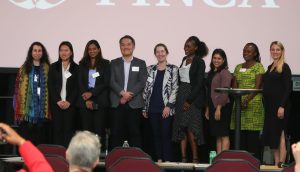
Winnie Mwangi unpacks why Africa is not just the continent to watch, but a force for driving long-term transformative change.
With over 17 years of experience guiding early-stage investments across Sub-Saharan Africa, FINCA Ventures’ new Managing Director, Winnie Mwangi, brings a rare combination of financial expertise, strategic insight, and deep regional knowledge to the world of impact investing. Now, she is leading FINCA’s efforts to back high-potential social enterprises that are improving lives across the continent.
Winnie’s career spans roles at prominent venture capital firms, including Bamboo Capital, LGT Impact, and Fanisi Capital, as well as the multinational professional service network PwC. She also serves as Jury President for the Anglophone and Lusophone Region at the prestigious Cartier Women’s Initiative. We sat down with Winnie to talk about her journey to impact-first investing, the promise of Africa’s entrepreneurial ecosystem, and how FINCA Ventures is working to unlock its full potential.
What drew you to impact investing, and what excites you most about it?
Throughout my career in venture capital, certain markets and demographics have remained underserved, despite the interests, attractiveness, and opportunities we have in Africa. I believe impact investing fills some of those gaps, which is why it’s been my pure focus for the last decade.
Joining FINCA Ventures was a natural continuation of what I love to do, and I’m excited to be part of an organization that sees things the way I see them. If I can play a role in shaping the story of the African entrepreneurial ecosystem, then I want to play that role.
What is it about FINCA Ventures that aligns so closely with your personal perspective?
For me, it’s the importance of understanding the local context. FINCA is a global organization committed to creating pathways out of poverty through sustainable, scalable solutions rooted in the specific and localized needs of the people it serves. Everything we do at FINCA — financial empowerment, impact investing, and research and innovation — is driven by the core belief that all people should have the opportunity to leverage their wisdom, talent, and effort to determine their own destiny.
Over the last 40 years, FINCA has prioritized the need to identify the key challenges faced by small entrepreneurs, listening to what they actually want and need to thrive in their communities. As the impact investing arm of FINCA, FINCA Ventures is hyper-focused on helping to scale innovative businesses that are driving economic and social progress.
When I’m looking at different business models, I ask: What is the context of this solution? Is it serving the market? What value is it adding? I always follow the value, looking to solve the challenges identified through insights and learnings from the communities we’re serving.
Another thing that attracted me to FINCA was the team of people willing to do the hard work. Hard work, in our case, is all the effort toward getting those consumer insights and informing our initiatives to address them. That passion and care about doing the challenging and purposeful things — and the unified voice and spirit to drive change — was contagious to me, and I wanted to be part of it.
Why is investing in and supporting women entrepreneurs so important to long-term social change?
Women-led businesses have historically been underfunded, yet women are powerful agents of inclusive growth. Both through the transformative solutions they provide for communities and their responsible use of capital, women create a multiplier effect that strengthens key social sectors and has a long-term impact on the ecosystem. So there’s both depth and scale when it comes to women-run businesses.
I want to see more women come forward with their business ideas and their business plans. Out of every 10 business plans submitted, I’m unlikely to see more than one (if any) from women. I think the reason is that women tend to set such high standards for themselves. I want to see more women taking that leap. They may not be 100% ready, but let’s not make perfect the enemy of good.
What is the most pressing issue facing African entrepreneurs today?
Funding, funding, funding. That remains the most pressing challenge. Less than 1% of global venture capital goes towards Africa. Plus, that limited amount of funding is chasing businesses that demonstrate positive cash flow and high growth — businesses that are already doing well. As a result, many entrepreneurs who are at a point in their businesses where capital is most needed are left out of the funding pipeline.
What gives you hope about the future of entrepreneurship in Africa?
Africa is the second fastest growing region of the world, so it presents a great consumer market opportunity. More than 60% of the population is in the youth bracket (under 25), who are now actively seeking to set up their own businesses and create change. That, alongside technological advancements, has catapulted growth in entrepreneurship and SMEs.
There are still challenges, but great things are in the making. I think investors who position themselves early enough, understand the market requirements, and see the potential — and who are willing to do the hard work and take the risk of funding these businesses at the early stage — will reap the benefits of seeing both how their capital will drive scale within the market, and the meaningful impact it is likely to create.
Can you give an example of an area where you think FINCA Ventures is driving transformational change?
FINCA’s global clientele has identified three essential factors for fostering their prosperity: income generation, resilience to shocks, and access to education. At FINCA Ventures, our work addresses all three of these priorities, with a particular emphasis on investments that strengthen resilience.
Within resilience, healthcare is always close to my heart and is an area where there are a lot of challenges. The majority of the African population is employed in the informal sector and doesn’t have access to medical healthcare. FINCA Ventures has made what I believe to be a transformational investment in MDaaS, a business based in Nigeria that seeks to improve access to high-quality and affordable diagnostic services by building and operating technology-enabled health centers in the fast-growing areas of underserved cities.
After our initial investment, we followed up with a second round of capital and hands-on support to help the business scale. That’s what we do at FINCA Ventures: We tap into our networks to help get businesses to a point where they can attract additional funding. We helped MDaaS build out its patient satisfaction survey, and we advise its board with strategic insights on raising capital. MDaaS is now one of the top diagnostic centers in Nigeria and has also expanded into Cameroon. Last year, the company served over 144,000 patients, 60% of whom were women, with plans to scale even further. The DNA of MDaaS is aligned with what FINCA Ventures is trying to do, and our provision of financial capital and post-investment support is what has enabled its transformation
What is your North Star as an investment team?
The FINCA Ventures all-women investment team is impact-focused and aligned on our goals. There’s a great story to tell, and it’s time to do that. If we want to drive change, let’s focus on building enterprises that are passionate about impact and whose core business is to truly transform underserved African communities.