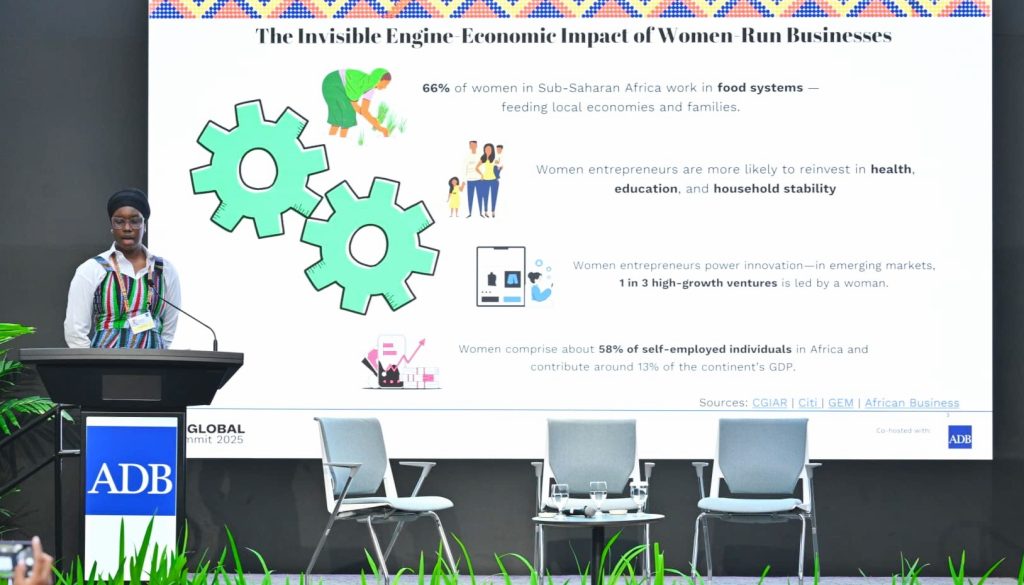
FINCA and the Gates Foundation held an interactive workshop to explore strategies for creating relevant products that enable women entrepreneurs to grow and thrive.
At the recent 2X Global Summit, organized around the theme of Women Driving Resilience, I heard the word “product” time and time again. As someone who works in product development, I can’t help but notice it. But I’m less interested in how often we talk about innovative products, and more in whether people actually use the ones we build.
The tension between access and usage isn’t new — it has been a central question in this sector for years. Yet, the latest Global Findex report makes clear that the issue is far from resolved: 79% of adults now have a financial account, but far fewer women actively use and derive value from higher-value products like savings, credit, and insurance. The divide is especially visible among women entrepreneurs. That’s why we need to continue to focus on what it will take to finally overcome this gap and design products that women will actively want to use.
Ultimately, a product is only as powerful as the progress it enables. And for many women entrepreneurs, progress doesn’t look like the familiar “ladder” we often imagine. Their journeys aren’t always linear, and their goals aren’t always about scaling upward.
When I think about how progress happens for women-led enterprises, I prefer the metaphor of a garden, because success in this context is an ecosystem. It’s about growth, resilience, and interdependence. And just like a garden needs the right conditions to thrive, women need products that are designed to fit their realities — tools that support not just access, but meaningful, sustained use.
Seeing Her Clearly
Why does this matter? Because across emerging markets, women are ambitious economic actors. In Sub-Saharan Africa, a majority of working-age women operate in food systems that feed local communities and families. One in three high-growth ventures is women-led, and these ventures are more likely to reinvest in health, education, and household stability. In short, women are drivers of economic growth and innovation — and yet, the products available to them rarely reflect their full operating reality.
Consider Fatima Syi, a talented tailor in Dakar, Senegal, running a small but thriving business mostly in cash with few digital records. She wants to expand into new markets and is already exporting to Zambia, but recently her growth has stalled. Like many women entrepreneurs, Fatima has been in business for years without formal registration, digital tools, or a way to prove her creditworthiness. She is essentially invisible to lenders and partners.
This is a systemic problem in many African markets. Foundational infrastructure gaps like limited ID coverage, fragmented payment networks, and unreliable data sources mean that too often, products are designed for an ideal customer who doesn’t exist, rather than for women like Fatima.
When products overlook these realities, women don’t use them — not because they lack ambition or capacity, but because the tools aren’t relevant. The real challenge is to build products that fit women’s lives, capture the value they are already creating, and support them in growing it further.
Designing for Her Reality
To create products that work for women, we need to start from a “baseline-building” mindset. If the data doesn’t exist, then products should help generate it through trust, records, and visibility. If usage is the problem, design is the lever we pull.
What would relevant product design look like for Fatima? An ideal solution would include:
- Asset finance for an embroidery machine to reduce third-party costs and increase margins.
- Simple recordkeeping tools to generate verifiable transaction and performance data.
- Market-access features such as order management, basic ecommerce, and distributor linkages.
- Insurance protection aligned to the real risks she faces.
Tailored lending isn’t just about bigger loans or gender-based marketing. It’s about meeting women where they are: combining microcapital with digital tools, incentivizing documentation, and linking credit-building to savings. It’s about designing market-entry packages that truly fit their day-to-day reality — how they sell, buy inputs, manage risk, hire staff, and expand.
In other words, design should turn every product into both a growth enabler and a data generator, helping women thrive today while building the visibility they need to access greater opportunities tomorrow.

Rethinking Success
For women entrepreneurs like Fatima, success doesn’t happen by climbing rungs, but by deepening roots and spreading branches. Nurturing the business might mean hiring another worker, acquiring a key machine, formalizing operations, stabilizing household income, or gradually accessing new financial services — from health and insurance to pensions. Like a garden, these elements flourish together, supporting one another and creating the conditions for scalable growth.
Getting there requires more than isolated fixes. Product teams and ecosystem partners — from policymakers and regulators to fintechs, investors, and grassroots organizations — must collaborate across finance, payments, insurance, market linkages, and digital tools that create actionable data. Designing for women’s realities means accounting for cash cycles, mobility constraints, childcare, and the complexities of cross-border trade. When that happens, the products do more than get used — they become engines of resilience and progress.
If we want to see the garden thrive, we have to design for the whole ecosystem, pushing beyond access toward meaningful, sustained use.

Karijatu Nadjiru spoke at an interactive workshop session held as part of the 2X Global Summit 2025 agenda. Kari was joined by James Onyutta, CEO of FINCA Uganda, and Janet Opolot, Senior Program Manager at the Gates Foundation, in their session on New Pathways to Finance for Women Entrepreneurs, Breaking Myths and Redesigning Products.
FINCA is working with the Gates Foundation’s Women’s Economic Empowerment program to expand access to productive credit for low-income women entrepreneurs in Uganda. Through product innovation, research, and technology development, the partnership is testing new financial solutions designed to improve women’s business growth, financial health, and overall resilience.