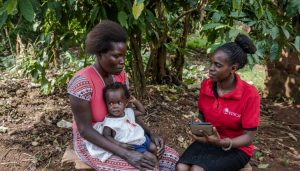

FINCA’s latest research challenges conventional thinking on how to understand and measure what drives women’s financial behavior.
Women’s economic empowerment (WEE) doesn’t happen in a vacuum — so neither should the way we measure it. By failing to account for the full reality of women’s lives, we risk mistaking access for progress.
Recent research shows that digital financial services have the potential to empower women, but translating that potential into tangible change is where the real challenge lies. The factors that shape women’s savings behavior are vast and complex — and highly shaded by cultural and gender norms. If we are to rigorously measure WEE, our indicators must reflect these essential nuances.
With funding from BRAC Institute of Governance and Development’s WEE-DiFine research grant, FINCA’s research and data science team investigated how family dynamics and gender roles influence women’s financial decision-making in Uganda. The study tested existing WEE indicators and adapted them to a localized context, identifying those that best reflect Ugandan women’s ability to set, act upon, and achieve savings goals. The result is a more robust and meaningful understanding of WEE measurement and a vital roadmap for future research.
A WEE Deep Dive in Uganda
Our findings are part of a larger randomized controlled trial looking at the effectiveness of goal-based digital savings accounts and services in Uganda. When preliminary data from an earlier study revealed that women were more responsive to financial coaching and had higher savings balances than men, our research team saw an opportunity for a follow-on measurement study to better understand these phenomena.
We employed a dual validation method to develop a series of WEE indicators that are relevant to the everyday savings practices of Ugandan women and highly efficient at predicting their agency.
Uganda provided a unique context for our research. Ugandan households are communal and dynamic, comprising a broad and evolving network of relatives and community members. Their size and structure change frequently due to economic and cultural factors — or sometimes for no clear reason at all. This profoundly impacted our research, from the wording of our surveys to the final outcomes.
The Delicate Balance of WEE
The follow-on study revealed a deep entanglement of savings motivators and obstacles, with women often expressing contradictory viewpoints and experiences. Product features are enabling in some situations but disempowering in others. Institutions’ efforts to improve personal savings are favorably received in some families and discouraged or punished in others.
The research also showed that demographic and socioeconomic variables can have mixed effects. For Ugandan women, children are both a primary motivation to save and the top hindrance to savings (due to the additional expense). Likewise, WEE measures can be outcomes in one instance and prior conditions in another — some women need greater independence to become better savers, while others need greater savings to become more independent.
For researchers and product developers, these insights underline the importance of being more open-minded with our hypotheses and recognizing the complexity of factors that contribute to shaping outcomes. No aspect of a product or service will be self-evidently beneficial under all circumstances.
The Overlooked Realities of Women’s Savings Decisions
Our dual-validated Uganda study found several prominent aspects impacting WEE measurement that were extremely local and rarely addressed in existing frameworks.
Fear — of divorce, illness, and especially aging — is another significant factor impacting women’s sense of agency in deciding how much to save for the future. Worried about who will be available to care for them as they grow older, many women adopt savings strategies aimed at securing their financial stability in later life.
Finally, Ugandan women can find it challenging to organize and manage their financial resources — complicating their decision-making and their ability to stay focused on financial goals. Behavioral coaching and clear and straightforward information are highly valued in helping them make better choices to achieve realistic financial objectives.
WEE frameworks that fail to incorporate these hidden factors not only distort our understanding of women’s empowerment but limit the effectiveness of the tools designed to promote it — and may even end up reinforcing the very barriers they aim to dismantle.
The Missing Link in WEE Measurement
One finding of great interest to researchers is how the fluidity of Ugandan household size impacts WEE measurement. Over the course of our survey, we saw dramatic fluctuations in the number of individuals living in a home and investigated further. We were surprised to discover how this circumstance influences nearly every aspect of women’s daily lives and economic empowerment.
Our participants emphasized that, because of this constant flux, focusing solely on husbands’ restrictions of women’s agency and decisions misses the pivotal roles of other household members, extended family, neighbors, friends, and the broader community.
Additionally, participants noted that ever-changing household dynamics introduce additional barriers — it’s not just about who or who else interferes with women’s control, but also what and what else. Restrictions on women derive not only from different people but also from the circumstances those people create.
Ugandan women face a complex and multifaceted landscape of empowerment restrictions. Fewer than 5 percent are restricted by only one person – the vast majority experience restrictions from multiple people and factors simultaneously. To get the full picture, we suggest broadening WEE metrics to encompass a comprehensive list of potential sources, individuals, and circumstances.
Empowerment, Dignity, and Measuring What Matters
Measuring WEE requires a precise and nuanced understanding of the communities and people we study. To get it right, we must move beyond traditional assumptions and metrics to measure what really matters, uncovering powerful insights that might otherwise remain hidden.
FINCA’s contextually grounded approach not only reflects the true experiences of women but also honors their dignity in navigating financial challenges with determination. We all recognize WEE’s potential, now we must step out of the vacuum and make it a reality.