Through a grant from the Hilton Foundation, FINCA is partnering to build the sustainability of Uganda’s early childcare development ecosystem with a two-generation approach.
Investing in early childhood development (ECD) is a proven tool for breaking poverty cycles, but education alone isn’t enough to end the hardships of the world’s most vulnerable communities. Families need more than classrooms and teachers — without financial security, they will always struggle to reach their full potential. Ultimately, a child’s education is only as strong as their family’s ability to support it.
In Uganda, it is estimated that up to 70% of children aged 3 to 5 lack access to early education, and ECD penetration is even scarcer in rural and refugee communities. Uganda is one of the world’s top refugee-hosting countries, with a population of displaced people that has tripled to over 1.8 million since 2016, consisting mostly of women and children dependent on humanitarian assistance.
Yet, despite common misconceptions, refugees are entrepreneurial, own businesses, and demonstrate a strong savings culture and aspirations toward financial independence. Supporting their livelihoods is crucial to ensuring their children maintain ongoing access to life-changing ECD programs.
In 2023, FINCA and a consortium of partners received a grant from the Conrad N. Hilton Foundation to address the lack of accessible ECD services in Uganda’s refugee-hosting communities using a two-generation approach of supporting both children and the adults who care for them within the same program. The two-year pilot is creating a new business model that integrates early childhood and livelihood outcomes for lasting impact.
Uganda’s ECD Landscape
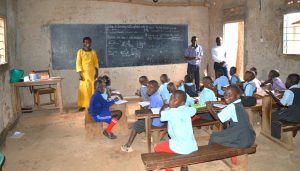
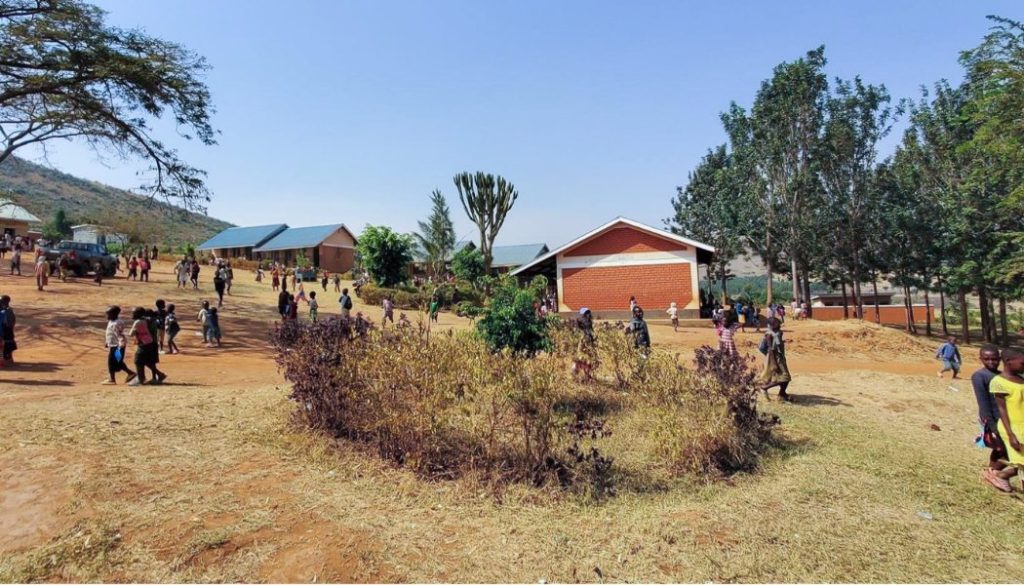
While positive change is evident in Uganda – the government recently adopted a new Early Childhood Education Policy and maintains a progressive approach to refugee integration – there are still gaps in delivering universal quality ECD. Community ECD centers are typically run by underpaid staff and tend to be poorly equipped and overcrowded. Most lack basic learning and play materials, and essentials such as electricity, clean water, and sanitation.
Currently, the public funding available for these services remains very limited, so local ECD centers and providers often depend on project-based grants from external donors. Without the ability to plan for sustainable revenue or funding in low-income areas, or to charge for their services, many effectively operate on a day-to-day basis. Our support keeps these centers running while families work toward affording services or until government aid becomes available.
A Two-Generation Approach
In line with the two-generation approach, FINCA’s pilot program aims to strengthen the sustainability of the ECD ecosystem for refugee and host children in Uganda. Working alongside partners Opportunity International UK, Opportunity Bank Uganda, PHB Development, as well as key local and refugee-led organizations, the project is focused on communities in Nakivale, Kiryandongo, and Kampala. Phase One (April 2023-2025) includes the prototyping, testing, and refining of business models and services for parents and caregivers, teachers, ECD leaders, and community support organizations.
Together with our partners, FINCA is taking a three-pronged, refugee-led approach:
- Supporting parents and caregivers: Parents and caregivers undergo training on how to start or grow income-generating activities, with a focus on developing their financial literacy and capacity to manage money and accounts. We connect them with financial services providers (FSPs) that can provide savings and loan products to back their endeavors. Furthermore, we proactively foster employment and entrepreneurship by prototyping and accelerating promising social enterprises and hiring from within the refugee community.
- Supporting ECD centers: ECD centers receive seed capital and capacity-building in governance, business model development, and financial planning and management. We link centers with FSPs and train their leaders on identifying and managing social investment vehicles and building sustainable income streams to help them transition from grant dependence to financial self-sufficiency. Our project also strengthens the ECD ecosystem as a whole by supporting advocacy, networking, and policy-making efforts.
- Supporting FSPs: Finally, we engage with financial institutions to equip them to serve this market more effectively and to see ECD as a commercially viable segment. This requires modifying existing loan products to meet the particular needs of these populations and developing new data analytics, credit scoring technologies, policies, and processes.
We believe this innovative strategy ensures that both generations get the tools they need to thrive and that ECDs achieve financial self-sufficiency so they may continue enriching lives and shaping futures.
Early results of the pilot program show that deep community engagement, local partnerships, and blended support teams are essential in fostering ECD growth. Cooperative structures, such as Village Savings & Loan Associations (VSLAs), help parents cover school fees and support ECD operations through income-generating activities – providing financial security while cultivating a sense of collective responsibility and mutual support.
Meanwhile, alternative financing mechanisms such as interest-free graduation loans are creating pathways for ECD centers to take on more commercial funding. As we work toward scaling up, we look forward to sharing more findings from this transformative two-generation journey.