FINCA’s Poverty Eradication Lab co-creates with communities, refines solutions through research and human-centered design, and scales what works to break systemic poverty barriers. Read on to find out how FINCA’s partnership with Jackfruit will help thousands of families realize their goal of sending their children to school.
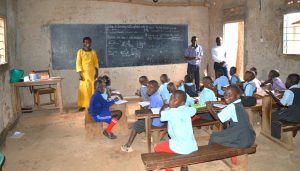
Imagine you are a parent living in a low-income neighborhood in Kampala, Uganda. You believe in the power of education and want to give your child the best possible start in life, but the nearby early childhood centers are overcrowded, under-resourced, or too expensive. Even when you find a decent school, keeping up with tuition is a constant struggle. You dip into savings originally meant for health emergencies, borrow from neighbors, or miss payments altogether — and more and more, your child stays home.
For many families, this is not a temporary hardship, but part of a deeper, more complex web of interconnected challenges. Beyond the burden of school fees, they must navigate an ecosystem where quality education, stable income, and financial tools rarely align. Systemic barriers, unpredictable shocks, and limited future opportunities reinforce each other, creating a cycle that is incredibly difficult to escape. Schools in underserved communities struggle to expand or improve because they lack financing. Parents with steady but limited incomes lack access to affordable credit. And children miss out on critical early learning that could set the foundation for a brighter future.
Now imagine a different reality: A school in your community receives a loan to build new classrooms and improve its learning environment. Teachers get better training, and the quality of education rises. A school fee loan designed around your income patterns ensures you can keep your child enrolled without falling into debt. Small interventions become a catalyst for real change, and the system starts to shift from one that holds families back to one that lifts them up.
This is where FINCA’s Poverty Eradication Lab comes in. The Lab designs new ways to fight poverty through nudge innovations: tiny but powerful adjustments to existing solutions that, once implemented, drive meaningful progress. Our work is grounded in a deep understanding of the challenges people face in their daily lives and the structural barriers that compound them, with the goal of making everyday systems work better for those most often left behind.
The Lab’s Innovation Cycles: A Framework for Sustainable Change
At the Lab, we understand that every individual, household, and community faces a unique combination of obstacles, and that the key to lasting impact is identifying the right set of interventions to address the specific needs of each situation. To do so, we structure our work into innovation cycles that guide how we uncover challenges, design solutions, and scale what works.
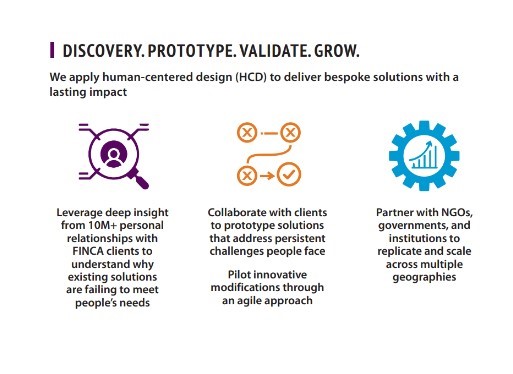
An innovation cycle at the Lab includes three core building blocks: deep discovery and research; human-centered design; and pilot, scale, and sustain. Each is informed by direct feedback from people and communities and aimed at long-term sustainability and scale.
1. Deep Discovery and Research
A Poverty Eradication Lab innovation cycle begins with rigorous, in-depth research. We immerse ourselves in people’s realities to understand who they are, how they live, what barriers they face, and where opportunities for change might lie. We go beyond individual stories to map the broader social, financial, environmental, and institutional forces at play. Through this lens, we identify the key areas where well-placed interventions can create a ripple effect of positive change.
The Lab put this strategy into action in Uganda, looking at how parents pay for school expenses and which factors help or hinder access to education. Using a blend of data analysis, in-depth interviews, focus groups, and case studies, we uncovered several patterns connected to income, location, school type, and community support.
One insight stood out from our research: Despite the recognized importance of early childhood education, enrollment remains extremely low at 9%, meaning that for many families, the cost of sending children to school is prohibitive. This presents a twofold challenge: first, making early childhood education more affordable without compromising quality; and second, expanding infrastructure and access in underserved areas so more children can benefit.
2. Human-Centered Design
With a grounded understanding of the problem, we move into design, co-creating interventions alongside individuals and communities, building prototypes, testing in real-world settings, and refining based on feedback. We also consider how multiple interventions connect, working together to create a more holistic response. Through this iterative and collaborative process, we seek to break through systemic barriers and create solutions that are practical, inclusive, and built to last.
In Uganda, we conducted field immersions and co-creation activities with parents, teachers, and school administrators. Our work resulted in four distinct child profiles, based on a rigorous evaluation of key factors such as location and demographics, school amenities and costs, teacher training and pedagogy, community and philanthropic support, and long-term educational goals.
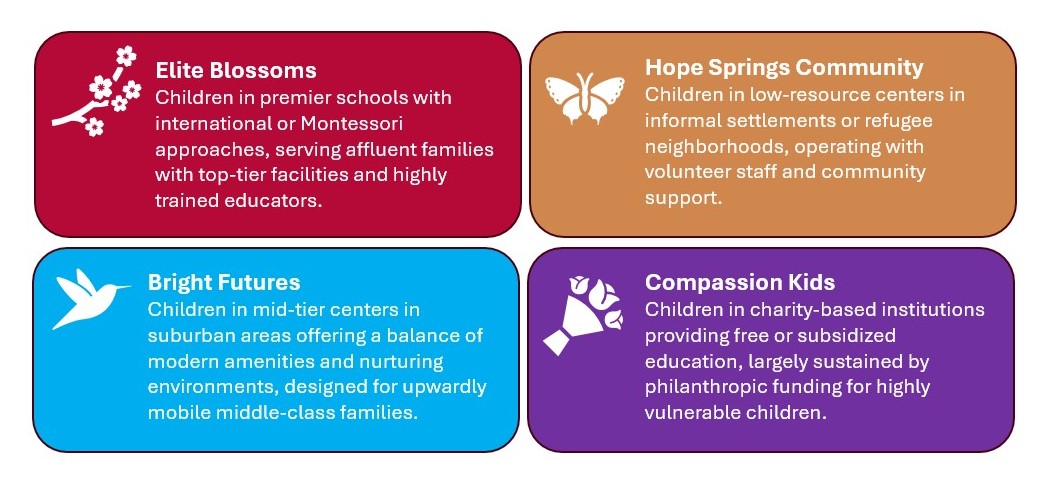
This segmentation revealed some critical insights. Even families with regular incomes often struggle to pay tuition on time, turning to informal lenders or pulling children out of school when money runs short. Meanwhile, many promising schools in underserved areas are unable to expand due to a lack of financing, even when demand is high.
In response, we co-designed a three-stage solution:
- Working capital loan: A product tailored to mid- and lower-tier schools to stabilize operations.
- Infrastructure loan: A product tailored to mid- and lower-tier schools to expand infrastructure and services, increase enrollment, and improve access in marginalized communities.
- School fee loan: A financing tool for parents with steady incomes, designed to ease the burden of tuition payments and enable access to higher-quality early education.
3. Pilot, Scale, and Sustain
Once solutions show early promise, we focus on testing them for viability, usability, and impact at a larger scale. This includes building business and financing models, evaluating sustainability, and ensuring relevance across contexts. We rigorously validate the business case for implementing partners and end users, and partner with FINCA’s financial services subsidiaries and other local organizations to root each solution in existing systems, ensuring their sustainability and self-sufficiency.
In Uganda, following our research and design work, we began building out the proposed solutions. We partnered with Jackfruit Finance and FINCA Uganda to initiate the first pilot, beginning with the infrastructure loan. The school fee loan will follow once the improvements in capacity and quality are underway.
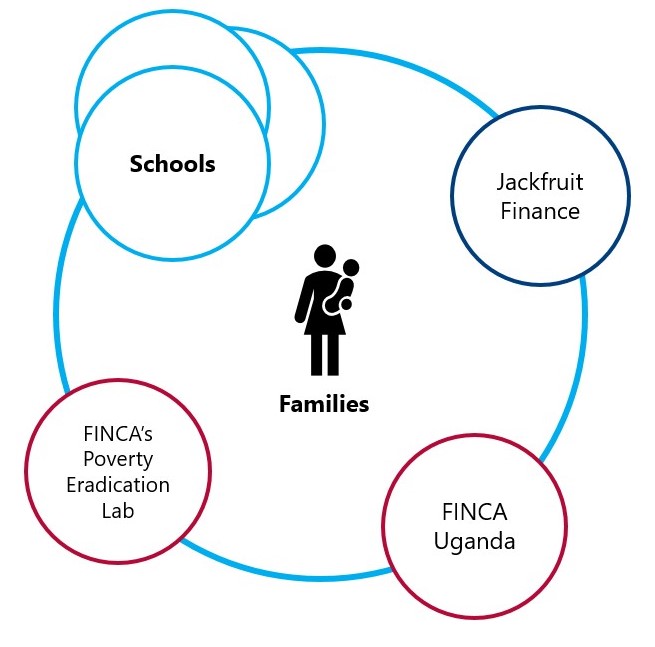
As the pilot progresses, we continue to apply our human-centered design approach to guide the next phases. Early feedback from participating schools helps us identify areas for improvement, while new questions prompt deeper research. Our goal is to refine and professionalize the solution into one that delivers meaningful impact and is ready to scale.
Scaling takes different forms depending on the solution. It can mean expanding across communities, nationally, or across the globally. But the goal remains the same: to reach more people, drive greater uptake, and maximize impact.
The Lab’s Innovation Cycles: A Framework for Sustainable Change
At the Poverty Eradication Lab, we’re not just experimenting, we’re building a movement grounded in insight, collaboration, and smart, scalable innovation. Our approach starts with understanding people’s realities, empowers them through design, rigorously tests what works, and scales solutions through local partnerships. That is how we turn good ideas into meaningful, measurable progress.